Is your “AI chatbot” actually intelligent, or is it just a fancy FAQ on autopilot?
If you’ve recently implemented a “chatbot” that claims to use “AI,” there’s a good chance you’ve been sold a glorified decision tree. And if you’re shopping for an “AI agent,” you might be overpaying for capabilities you don’t actually need.
Marketing teams slap “AI-powered” on basic if-then chatbots.
Meanwhile, genuinely intelligent AI agents get lumped into the same category as rigid, script-following bots that break the moment a customer asks something unexpected.
A traditional chatbot can handle “What are your business hours?”
A true AI agent can understand “I’m in Singapore and need to know if you’re open when I finish work at 6 PM.”
One follows a script. The other understands context, time zones, and intent.
The confusion has real consequences.
Companies waste thousands deploying AI agents for simple tasks that could be automated with basic chatbots. Others frustrate customers with rigid chatbots when they actually need intelligent, adaptive conversations.
So what’s the real difference? When does a chatbot become an AI agent? And more importantly, which one does your business actually need?
In this comprehensive guide, we’ll dissect both technologies without the marketing fluff. You’ll see real examples, including how platforms like WhatChimp enable businesses to use both traditional automation and AI intelligence on WhatsApp, to understand exactly what each technology can (and can’t) do.
Let’s end the confusion and start with what actually matters: getting the right technology for your business goals.
What is a Chatbot?
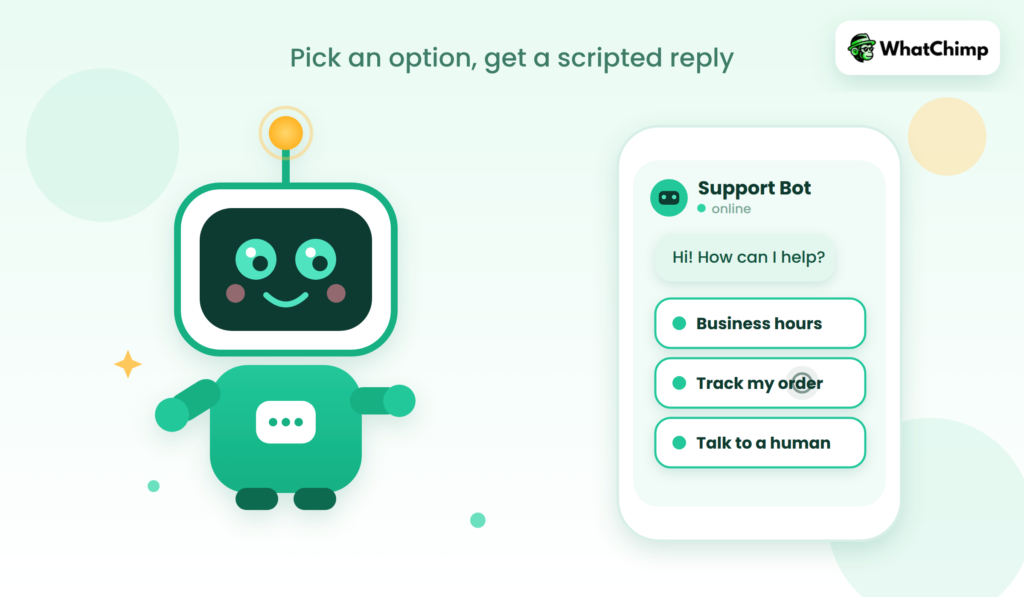
A chatbot is a software program designed to automate conversations with users through pre-programmed responses and rule-based logic. Unlike human agents who can think critically and adapt to context, chatbots follow predetermined scripts and decision trees to respond to user queries.
The fundamental architecture of a traditional chatbot is simple: it recognizes specific keywords or phrases in user input and matches them to pre-written responses stored in its database.
When a user asks “What are your business hours?”, the chatbot identifies the keyword “business hours” and retrieves the corresponding answer.
This is essentially an automated version of a FAQ page, delivered through a conversational interface.
Traditional chatbots operate on “if-then” conditional logic. If a user says X, then the bot responds with Y.
This makes them highly predictable, consistent, and effective for handling repetitive queries at scale.
Core Features
✅Rule-Based Logic: Chatbots function on predetermined rules and scripts. Every possible user input must be anticipated and programmed in advance.
✅Keyword and Pattern Matching: The system scans user messages for specific words or phrases to determine intent. When it finds a match, it triggers the associated response.
✅Structured Conversation Flows: Most chatbots guide users through linear conversation paths using buttons, quick replies, or menu options. This reduces ambiguity and keeps interactions within the bot’s capabilities.
✅Pre-Written Responses: Every answer is written in advance and stored in the system. The chatbot cannot generate new content or customize responses beyond basic variable insertion (like adding a user’s name).
✅Limited Contextual Understanding: Traditional chatbots treat each message as an isolated event. They don’t retain conversation history or understand how previous exchanges relate to current queries. Users often need to repeat information, even within the same conversation.
✅Easy Implementation: Modern no-code platforms allow non-technical teams to build chatbots using visual flow builders. Setup is relatively quick and inexpensive compared to more sophisticated automation technologies.
✅Scalable Automation: Once deployed, a chatbot can handle unlimited simultaneous conversations without additional cost or resources. This makes them effective for businesses dealing with high volumes of repetitive queries.
Where Chatbots Work Best
👉Customer questions are predictable and repetitive
👉Interactions follow a clear, linear path from start to finish
👉The volume of inquiries is high but the complexity is low
👉Consistent, standardized responses are required
👉Budget constraints make more sophisticated solutions impractical
Common applications include basic customer support, appointment scheduling, order status checks, FAQ automation, simple lead capture forms, and routine information delivery.
What is an AI Agent?
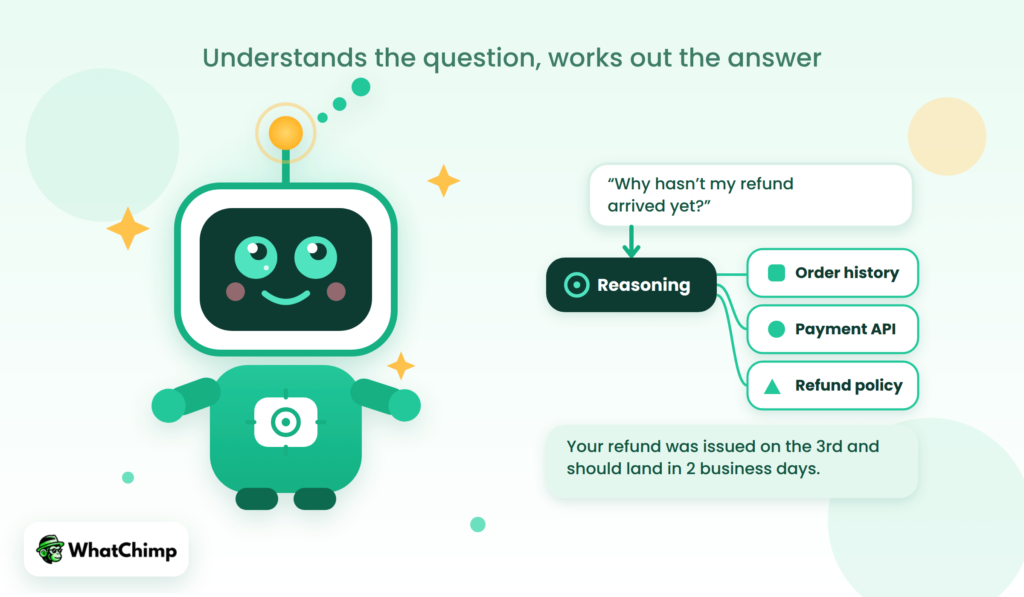
An AI agent is an intelligent software system that uses machine learning, natural language processing, and contextual understanding to engage in dynamic, human-like conversations.
Unlike traditional chatbots that follow fixed scripts, AI agents can comprehend intent, learn from interactions, make autonomous decisions, and adapt their responses based on context.
The key distinction lies in how AI agents process information.
Instead of matching keywords to pre-written responses, they use large language models (LLMs) and machine learning algorithms to understand the meaning behind user queries. This allows them to handle complex, multi-layered questions, maintain context throughout conversations, and generate original responses that weren’t explicitly programmed.
Core Features
🎯Natural Language Understanding (NLU): AI agents comprehend the intent and meaning behind user messages, not just specific keywords. This allows for natural, human-like conversations.
🎯Contextual Awareness: Unlike chatbots that treat each message independently, AI agents maintain conversation context. This creates a coherent, flowing conversation experience.
🎯Dynamic Response Generation: AI agents generate responses in real time based on understanding and available information, rather than retrieving pre-written scripts.
🎯Intent Recognition: Beyond understanding words, AI agents identify what users are trying to accomplish. They can distinguish between someone asking for product information, lodging a complaint, or requesting technical support even when the phrasing is indirect or ambiguous.
🎯Multi-Language Support: Many AI agents can understand and respond in multiple languages without requiring separate programming for each language. They can even detect language switches mid-conversation and respond accordingly.
🎯Emotional Intelligence: Sophisticated AI agents can detect sentiment and emotional tone in user messages. They can adjust their responses to be more empathetic with frustrated customers, more enthusiastic with excited prospects, or more formal in professional contexts.
Where AI Agents Excel
📌Customer inquiries are diverse, complex, and unpredictable
📌Conversations require context and memory across multiple exchanges
📌Personalization significantly impacts customer experience and conversion
📌24/7 intelligent support is needed without expanding human staff
📌Sales qualification requires understanding nuanced buyer intent
Common applications include advanced customer support, intelligent sales assistance, personalized product recommendations, complex troubleshooting, lead qualification and nurturing, and handling sensitive customer issues that require empathy and judgment.
The Trade-Off
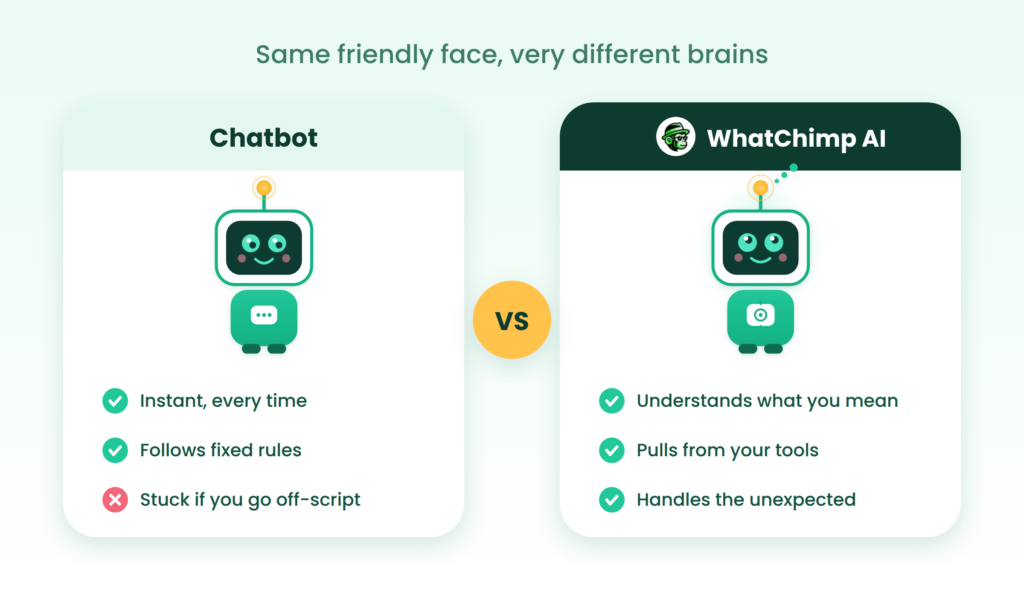
AI agents offer significantly more sophisticated capabilities than traditional chatbots, but they come with higher implementation costs, require quality training data, need ongoing monitoring and optimization, and can occasionally produce unexpected or incorrect responses (known as “hallucinations”).
The decision to deploy an AI agent should be based on whether the business problem requires genuine intelligence or if rule-based automation would suffice.
This is why many businesses are now adopting hybrid approaches—using traditional chatbot automation for predictable tasks while deploying AI agents for complex interactions that demand real understanding.
Key Differences Between AI Agents and Chatbots
| Aspect | Traditional Chatbot | AI Agent |
| Core Technology | Rule-based logic and keyword matching | Machine learning and natural language processing |
| Response Method | Pre-written scripts and templates | Dynamic, real-time response generation |
| Understanding | Recognizes specific keywords and phrases | Comprehends intent and contextual meaning |
| Conversation Flow | Linear, predetermined paths | Non-linear, adaptive conversations |
| Context Retention | Treats each message independently | Maintains conversation history and context |
| Learning Capability | Static—requires manual updates | Learns and improves from interactions over time |
| Handling Complexity | Best for simple, repetitive queries | Manages multi-layered, complex conversations |
| Personalization | Limited to basic variable insertion (name, date) | Deep personalization based on user behavior and history |
| Flexibility | Can only handle programmed scenarios | Adapts to unexpected questions and situations |
| Error Handling | Displays generic error messages or fails | Asks clarifying questions and attempts to understand |
| Multi-Turn Conversations | Struggles with extended back-and-forth dialogue | Excels at complex, multi-step problem solving |
| Language Understanding | Exact or close keyword matches required | Understands variations, slang, and natural phrasing |
| Decision Making | Follows predetermined rules only | Makes autonomous decisions within defined parameters |
| Setup Complexity | Quick and straightforward | Requires training data and configuration |
| Implementation Cost | Low to moderate | Moderate to high |
| Maintenance | Manual script updates needed | Periodic retraining and optimization |
| Predictability | 100% predictable responses | May produce varied responses to similar queries |
| Accuracy | Perfectly consistent within scope | High accuracy but occasional errors possible |
| Scalability | Excellent for high-volume simple tasks | Excellent for high-volume complex interactions |
| Use Case Fit | FAQs, booking, order tracking, basic lead capture | Customer support, sales qualification, personalized assistance |
| Human Escalation | Frequent—when query falls outside programming | Less frequent—only for truly complex issues |
| Training Data Requirement | None—just scripting | Requires quality data to train effectively |
| Best For | Predictable, repetitive, high-volume queries | Diverse, nuanced, context-dependent interactions |
How WhatChimp Bridges Chatbots and AI Agents
Understanding the theoretical differences between chatbots and AI agents is valuable, but seeing how businesses actually deploy both technologies reveals the practical strategic advantage.
WhatChimp, a WhatsApp marketing platform, demonstrates how the hybrid approach works in practice offering traditional chatbot automation alongside AI agent capabilities on a single platform.

The Platform Foundation
WhatChimp operates on the official WhatsApp Business API with one significant difference from competitors: zero markup fees. While most providers add 20-25% on top of Meta’s conversation charges, WhatChimp passes through Meta’s base rates directly, saving businesses up to 35% per conversation.
More importantly, the platform supports both traditional chatbot automation and AI agent capabilities within the same interface. This means businesses don’t need to choose between technologies or switch platforms as their needs evolve.
Traditional Chatbot Features
WhatChimp’s no-code bot builder lets non-technical teams create rule-based conversation flows through a visual interface. These chatbots handle predictable scenarios effectively:
✅FAQ automation with keyword-triggered responses
✅Multi-agent routing that escalates complex queries to human teams via shared inbox
✅Data collection through conversational forms that replace external landing pages
✅Broadcast messaging using approved templates for campaigns and notifications
These features work reliably for repetitive, high-volume interactions where consistency and speed matter more than intelligence.
AI Agent Capabilities
Beyond scripted automation, WhatChimp’s AI agent can be trained on business-specific content—websites, PDFs, product catalogs, and documentation. This creates an intelligent system that understands context, answers nuanced questions, and qualifies leads through natural conversation.
The practical difference shows clearly in results.
Case Study: E-Startup India
E-Startup India, a business consulting firm, was losing leads through traditional landing page funnels. Prospects clicked ads, saw forms, and abandoned them before submitting.
They replaced the entire funnel with Click-to-WhatsApp ads. Now prospects go straight into conversation with WhatChimp’s AI agent, which:
- Asks qualifying questions naturally based on responses
- Understands whether prospects need compliance, tax, or registration services
- Routes qualified leads to the right team member automatically
According to founder Pulkit Gupta, form abandonment dropped to zero. Every prospect who clicks enters a conversation, and the AI qualifies them in real-time without human intervention.
The Strategic Advantage
WhatChimp’s value is enabling businesses to deploy each where it works best:
Use chatbot automation for:
🟢High-volume repetitive queries with standardized answers
🟢Data collection workflows with predictable sequences
🟢Compliance scenarios requiring controlled messaging
🟢Budget-conscious automation
Use AI agent capabilities for:
⚡Diverse, unpredictable customer questions
⚡Sales qualification requiring conversational nuance
⚡Complex support across varied product catalogs
⚡Scenarios where personalization drives conversion
The 0% markup model means businesses can experiment with both approaches without cost penalties, optimizing based on actual performance rather than budget constraints.
This demonstrates the core insight: chatbots and AI agents aren’t competing solutions. They’re complementary technologies that, when strategically combined, create customer experiences neither can deliver alone.
When to Choose a Chatbot vs an AI Agent
The decision between deploying a traditional chatbot or an AI agent is about which one fits your specific business needs.
- The wrong choice leads to frustrated customers, wasted budget, or missed opportunities.
- The right choice automates effectively while delivering the experience your customers expect.
Let’s examine practical scenarios where each technology excels, helping you determine which approach matches your situation.
Uses Cases of ChatBot
🎯Use Case 1: E-commerce Order Tracking
An online retail business receives hundreds of daily inquiries asking “Where’s my order?” These queries follow an identical pattern: customer provides order number, system retrieves tracking information, customer receives status update.
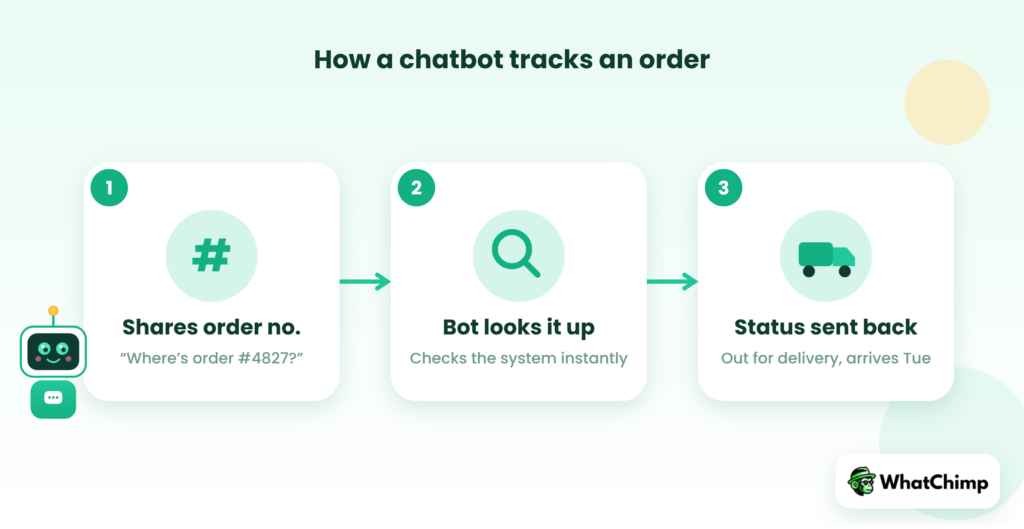
This scenario is perfect for a traditional chatbot.
The workflow is completely predictable, the required information is structured, and the response follows a simple lookup process. There’s no ambiguity, no need for judgment, and no benefit to dynamic conversation.
A rule-based chatbot handles this efficiently at scale without any risk of providing incorrect information.
🎯Use Case 2: Appointment Booking for Dental Clinics
A dental practice wants to automate appointment scheduling outside business hours. The process is straightforward: check availability, collect patient information, confirm preferred time slot, send confirmation.
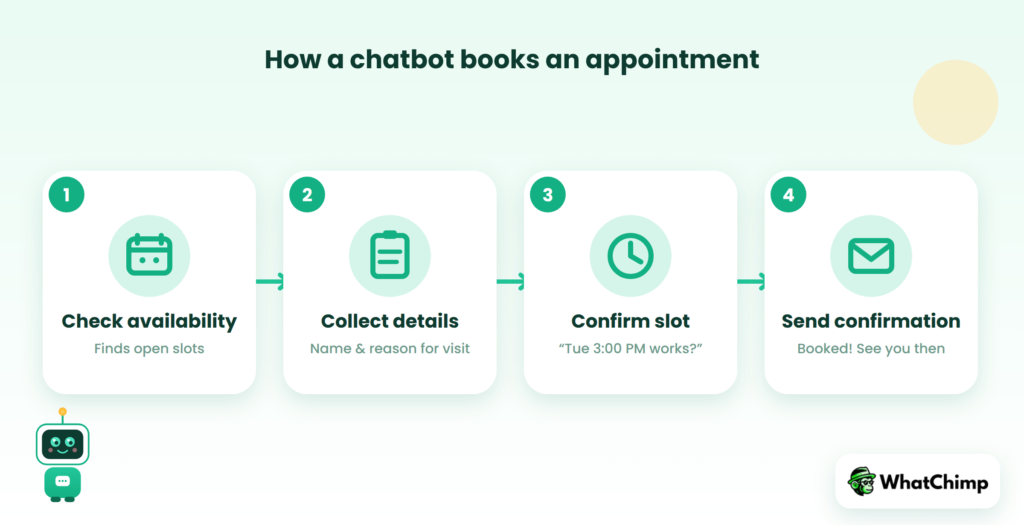
A chatbot excels here because the conversation follows a linear path with defined steps.
The bot can present available time slots as buttons, collect necessary information through structured questions, and confirm bookings without interpretation or nuance.
The predictable nature of appointment scheduling is just reliable automation.
Use Cases of AI Agent
📌Use Case 1: SaaS Technical Support
A software company offers a complex product with hundreds of features, multiple integration options, and diverse user configurations.
Customer support queries range from “How do I export data to Excel?” to “Why isn’t my API webhook triggering?” to “Can your platform handle multi-currency accounting?“
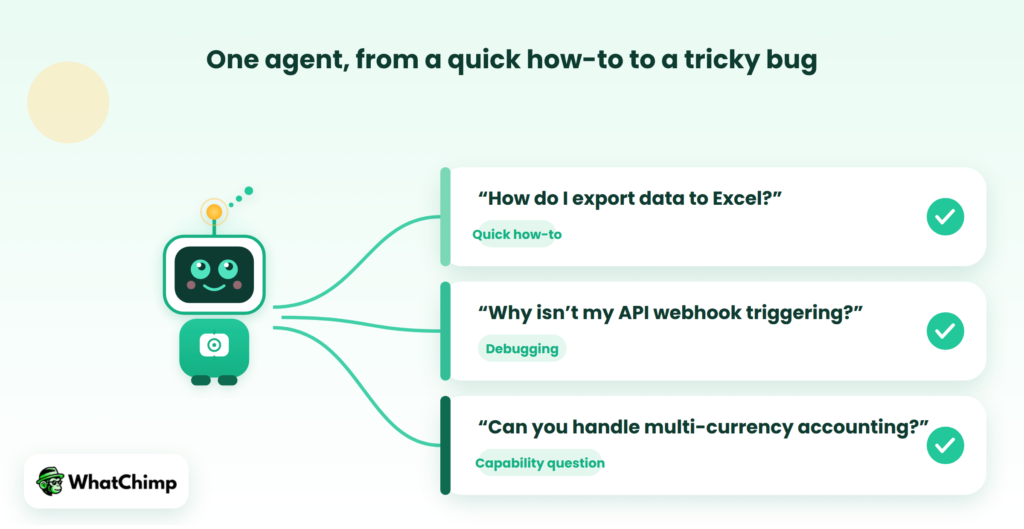
An AI agent trained on the company’s documentation, support tickets, and knowledge base can understand these varied questions and provide contextually relevant answers.
Unlike a chatbot that would require programming for every possible technical question, the AI agent comprehends intent, synthesizes information from multiple sources, and generates helpful responses even for questions it hasn’t explicitly been programmed to handle.
📌Use Case 2: B2B Sales for Complex Products
A manufacturing company sells industrial equipment with hundreds of configurations, pricing based on specifications, and solutions tailored to different industries.
Prospects ask questions like “What would work for a 5,000 square foot facility processing about 200 units per hour?” or “How does your system compare to [competitor] for food-grade applications?“
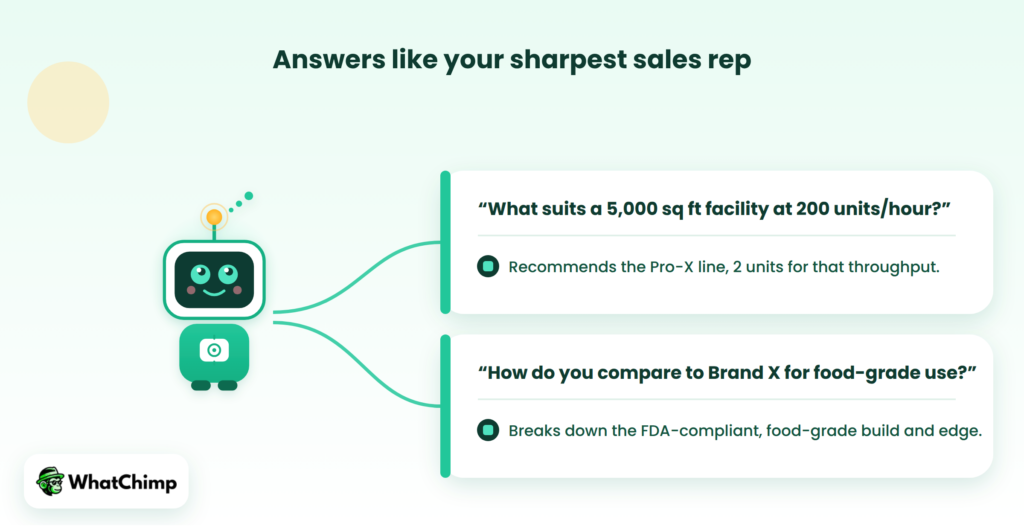
An AI agent can understand these complex, open-ended inquiries, consider multiple variables simultaneously, provide relevant comparisons, and qualify whether the prospect is a good fit.
This level of sales intelligence would require thousands of scripted scenarios in a traditional chatbot, making implementation impractical.
The Hybrid Solution: Getting the Best of Both Worlds
The most effective automation strategies don’t force an either/or decision. Instead, they deploy each technology where it performs best.
Consider an insurance company using this hybrid approach:
💡Chatbot handles: Policy document requests, payment confirmations, coverage amount lookups, office location information
💡AI agent handles: Claims description and initial assessment, coverage recommendations based on customer situation, complex policy questions requiring interpretation
💡Result: The majority of simple inquiries are automated cost-effectively, while complex interactions receive intelligent handling without requiring immediate human intervention
Platforms like WhatChimp enable this hybrid strategy without requiring separate tools or technical integration.
Conclusion
The distinction between chatbots and AI agents directly impacts your customer experience, operational efficiency, and bottom line.
- Chatbots automate through predictability and structure, making them ideal for repetitive, high-volume tasks where consistency matters more than intelligence.
- AI agents bring genuine understanding and adaptability, excelling in complex scenarios where context, nuance, and personalization create measurable business value.
But it’s recognizing that the either/or framing is fundamentally flawed.
They’re strategically deploying both. They use chatbot automation to handle the predictable foundation of customer interactions efficiently, then layer AI intelligence on touchpoints where understanding and adaptation directly influence conversion, retention, or satisfaction.
This hybrid approach is practically accessible.
Platforms like WhatChimp demonstrate that businesses don’t need separate tools, technical teams, or massive budgets to implement both technologies. With zero markup fees on Meta’s API and both rule-based and AI capabilities in a single interface, the barrier to intelligent automation has dropped significantly.
The technology exists.
The platforms are accessible.
The question is whether you’ll deploy automation strategically or continue handling manually what could be automated intelligently.
Your customers are already on messaging platforms like WhatsApp, expecting immediate responses and personalized interactions.
The conversation between chatbots and AI agents is about complementarity. The businesses that understand this distinction, and act on it, will build the customer experiences that define their industries.