How Businesses Use WhatsApp Alongside Social Media for Success
Discover how businesses combine WhatsApp with social media marketing to boost engagement, improve conversions, and grow.

On this page
In today’s fast-moving digital world, businesses are no longer relying on a single platform to connect with their audience. Instead, they are combining multiple channels to create a seamless communication experience.
Among these, WhatsApp and social media platforms have emerged as a powerful combination. When used together, they can significantly improve customer engagement, boost conversions, and strengthen brand loyalty.
This article explores how businesses are successfully using WhatsApp alongside social media marketing, while also integrating modern approaches like AI business consulting and AI in business strategy to stay ahead of the competition.
The Growing Importance of Multi-Channel Communication
Customers today expect quick responses, personalized interactions, and easy access to brands. Social media platforms like Facebook, Instagram, and Twitter are excellent for visibility and content distribution. However, they often lack the direct, personal touch that messaging apps provide.
This is where WhatsApp becomes a game-changer. With its instant messaging capabilities, businesses can move conversations from public social platforms to private, more meaningful interactions. This combination allows brands to attract, engage, and convert customers more effectively.
Using Social Media to Drive Traffic to WhatsApp
One of the most common strategies businesses use is leveraging social media marketing to bring users onto WhatsApp. Social platforms act as the top of the funnel, where businesses create awareness through posts, ads, reels, and stories.
Once users show interest, they are encouraged to click a “Chat on WhatsApp” button. This transition is powerful because:
✅It shifts communication from passive browsing to active conversation
✅It increases the chances of conversion
✅It allows businesses to provide instant support
For example, an online store may showcase products on Instagram and then guide customers to WhatsApp for inquiries, pricing, and order placement.
Personalized Customer Engagement
Unlike traditional social media interactions, WhatsApp allows businesses to have one-on-one conversations with customers. This level of personalization builds trust and improves customer satisfaction.
Businesses can use WhatsApp to:
🎯Answer product-related questions
🎯Provide recommendations based on customer needs
🎯Share order updates and delivery details
🎯Offer exclusive deals and promotions
When combined with insights gained from social media marketing, these conversations become even more targeted and effective.
Role of AI in Business Strategy
Modern businesses are increasingly integrating AI in business strategies to enhance their communication efforts. AI tools can analyze customer behavior, preferences, and engagement patterns across social media and WhatsApp.
For instance:
👉AI can identify which social media campaigns drive the most WhatsApp inquiries
👉It can suggest the best time to send messages
👉It can personalize responses based on user data
This data-driven approach helps businesses make smarter decisions and improve overall performance.
Automating Communication with AI Business Consulting
Another major advantage comes from AI business consulting, which helps companies implement automation tools like chatbots and smart reply systems.
With AI-powered WhatsApp automation, businesses can:
📌Instantly respond to common queries
📌Handle multiple customers at once
📌Provide 24/7 customer support
📌Reduce manual workload
For example, a whatsapp chatbot can greet users who arrive from a social media ad and guide them through product options, pricing, and even checkout processes.
This not only improves efficiency but also ensures that no potential customer is left waiting.
Building Strong Customer Relationships
While social media is great for attracting attention, WhatsApp excels at building long-term relationships. Businesses can use it to stay connected with their audience even after the initial purchase.
Some effective strategies include:
🔸Sending follow-up messages after a purchase
🔸Sharing personalized offers
🔸Providing customer support
🔸Asking for feedback and reviews
These ongoing interactions help turn one-time buyers into loyal customers.
Enhancing Marketing Campaigns
Combining WhatsApp with social media marketing also enhances the effectiveness of marketing campaigns. Businesses can create integrated campaigns that guide users through a complete journey.
For example with Click to Whatsapp ads:
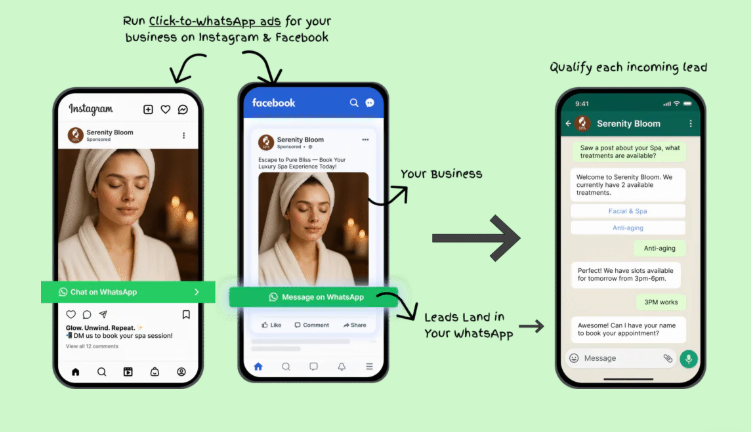
⚡A user sees a product ad on social media
⚡They click a link and start a WhatsApp chat
⚡They receive detailed information and personalized offers
⚡They complete the purchase within the chat
This smooth transition reduces friction and increases conversion rates.
Data Collection and Insights
Another key benefit is the ability to collect valuable customer data. Social media platforms provide insights into audience behavior, while WhatsApp offers direct feedback through conversations.
By combining these data sources, businesses can:
📍Understand customer preferences
📍Improve product offerings
📍Optimize marketing strategies
📍Refine their AI in business strategy
This continuous learning process is essential for long-term success.
Cost-Effective Marketing Approach
Using WhatsApp alongside social media is also a cost-effective strategy. Social media platforms help reach a large audience at a relatively low cost, while WhatsApp enables direct communication without additional advertising expenses.
When supported by AI business consulting, businesses can further reduce costs by automating repetitive tasks and improving efficiency.
Final Thoughts
The combination of WhatsApp and social media is transforming how businesses communicate with their customers. Social media marketing helps attract and engage audiences, while WhatsApp provides a direct and personal channel for conversion and relationship building.
By integrating advanced technologies like AI in business strategy and leveraging AI business consulting, companies can take this approach to the next level. The result is a smarter, faster, and more effective communication system that drives real business success.
Businesses that adopt this multi-channel strategy today are better positioned to meet customer expectations and stay competitive in the digital age.