Wati pricing 2026 (India): plans, per-message charges and what you really pay
Wati pricing in India for 2026: plan prices in ₹, per-message charges vs Meta's rates, add-ons, GST and three worked monthly bills you can copy.


On this page
What this guide covers
- Key takeaways
- Wati pricing in India: the quick answer
- What do Wati’s plans include, and where are the limits?
- What your Wati bill is NOT: common myths
- How does WhatsApp message pricing work in 2026?
- How much does Wati charge per message compared with Meta?
- What add-ons and hidden costs should you expect?
- What does Wati really cost? 3 worked examples
- When is Wati worth the price?
- Is there a cheaper option with 0% markup?
- How do you estimate your own WhatsApp bill?
- Conclusion
- FAQs
Key takeaways
- On quarterly billing, Wati pricing in India starts at ₹2,699 a month for Growth, ₹5,799 for Pro and ₹16,799 for Business (checked on wati.io on 6 November 2026).
- Your plan fee doesn’t cover WhatsApp messages. You prepay credits, and Wati’s rate card charges more per message than Meta’s own rates.
- Since 1 October 2026, Meta charges for service replies once a number goes past 1,000 free ones a month, so support-heavy teams now pay for replies too.
- Add 18% GST to both the plan fee and the message charges before you decide whether a plan fits your budget.
- If messages are the biggest line on your bill, a platform that adds 0% markup to Meta’s fees will cut the line that grows fastest.
What if I told you Wati’s ₹5,799 Pro plan could turn into a bill of nearly ₹60,000 a month?
You’d probably think I’m exaggerating.
I’m not. I worked through exactly that bill for a mid-sized Shopify store, and you’ll see every line of it further down.
Here’s what usually happens. You see a Wati ad, book a demo, like the dashboard and look at the plan cards. The plan price looks fair. You sign up, run your first Diwali broadcast, and the wallet empties much faster than you planned.
The plan price was never the real cost.
I’m Anant, and I run WhatChimp, so yes, I have a horse in this race. That’s why every number in this guide comes with a source and a date. I’ll show you Wati’s current ₹ prices, what each plan includes, how WhatsApp message charges work after the October 2026 changes, how Wati’s per-message rate compares with Meta’s, and three worked monthly bills for typical Indian businesses.
Then you can decide with real numbers.
Wati pricing in India: the quick answer
Wati has three plans: Growth, Pro and Business. These are the India prices on Wati’s pricing page with quarterly billing selected, which I last checked on 6 November 2026.
| Plan | Price per month (billed quarterly) | Users included | Extra user |
|---|---|---|---|
| Growth | ₹2,699 | 3 | Can’t add more |
| Pro | ₹5,799 | 5 | ₹1,299 per user per month |
| Business | ₹16,799 | 5 | ₹2,199 per user per month |
On top of the plan you pay for:
- Every WhatsApp message you send, from a prepaid credit balance
- Any add-ons you need (automation triggers, AI credits, Shopify, extra numbers)
- 18% GST on the whole lot
The page also has a Monthly, Quarterly and Annual toggle labelled “Save up to 10%”. Third-party trackers report bigger gaps than 10% between monthly and annual prices, so flip the toggle yourself on the day you buy and note the exact figure.
Outside India, Wati shows prices in your local currency. If you’re comparing the Wati price for a US or UAE number, check the page from that country.
Pro tip: Screenshot the pricing page with the toggle you picked and the date showing. If the price changes later, you’ll know exactly what you signed up for.
Free trial, setup fee, cancellation and refunds
Wati’s pricing page says “7 days free trial, zero setup fees”. It also says:
- ✅ No setup fee and no cancellation fee
- ✅ Upgrades are prorated, and downgrades take effect at the end of your billing cycle
- ❌ No refunds “on payments made for your existing subscription or credits”
That last one matters. Whatever you top up in your wallet stays there, even if you leave.
What do Wati’s plans include, and where are the limits?
The plan cards look similar at first glance. The limits are where the real differences sit.
Here’s what Wati’s pricing page and its plan comparison page list:
| Feature | Growth | Pro | Business |
|---|---|---|---|
| Broadcasts per month | 15,000 | Unlimited | Unlimited |
| Automation triggers per month | 1,000 | 2,000 | 5,000 |
| Wati AI credits | 2,000 | 5,000 | 20,000 |
| Chatbots | 2 | Unlimited | Unlimited |
| Integrations | 2 | 5 (incl. HubSpot) | Unlimited (incl. Salesforce) |
| API calls | 10K, no webhooks | 200K | 20M |
| Messaging speed | 20 msgs/sec | 40 msgs/sec | 80 msgs/sec |
| Message pricing | Wati rate card | Wati rate card | 5% off Wati rate card |
1. Users: Growth stops at 3, full stop
Growth includes 3 users and you can’t add a fourth.
So if you have four people answering customers, you’re on Pro. That’s the jump from ₹2,699 to ₹5,799 a month, before a single message goes out.
2. Automation triggers: the cap most people miss
This is the MOST important limit on the page.
Every time an automation fires (a welcome flow, an abandoned cart nudge, a keyword reply) it uses a trigger. Growth gives you 1,000 a month and Pro gives you 2,000.
Example in action: Priya runs a coaching centre in Pune. Her auto-reply sends “Hi! Thanks for asking about our NEET batch. Reply 1 for fees, 2 for timings” to every new enquiry. During admission season she gets 60 enquiries a day. That’s 1,800 triggers a month from one flow, which is already past the Growth cap.
More triggers are an add-on (₹1,000 a month on Wati’s page), and the page doesn’t make clear how many triggers that price covers. Ask before you buy.
3. Webhooks and API calls on Growth
Growth has no webhooks and 10,000 API calls.
If you want WhatsApp to talk to your CRM or order system in real time, plan for Pro.
What your Wati bill is NOT: common myths
I hear these four every week from people who’ve just moved over from Wati.
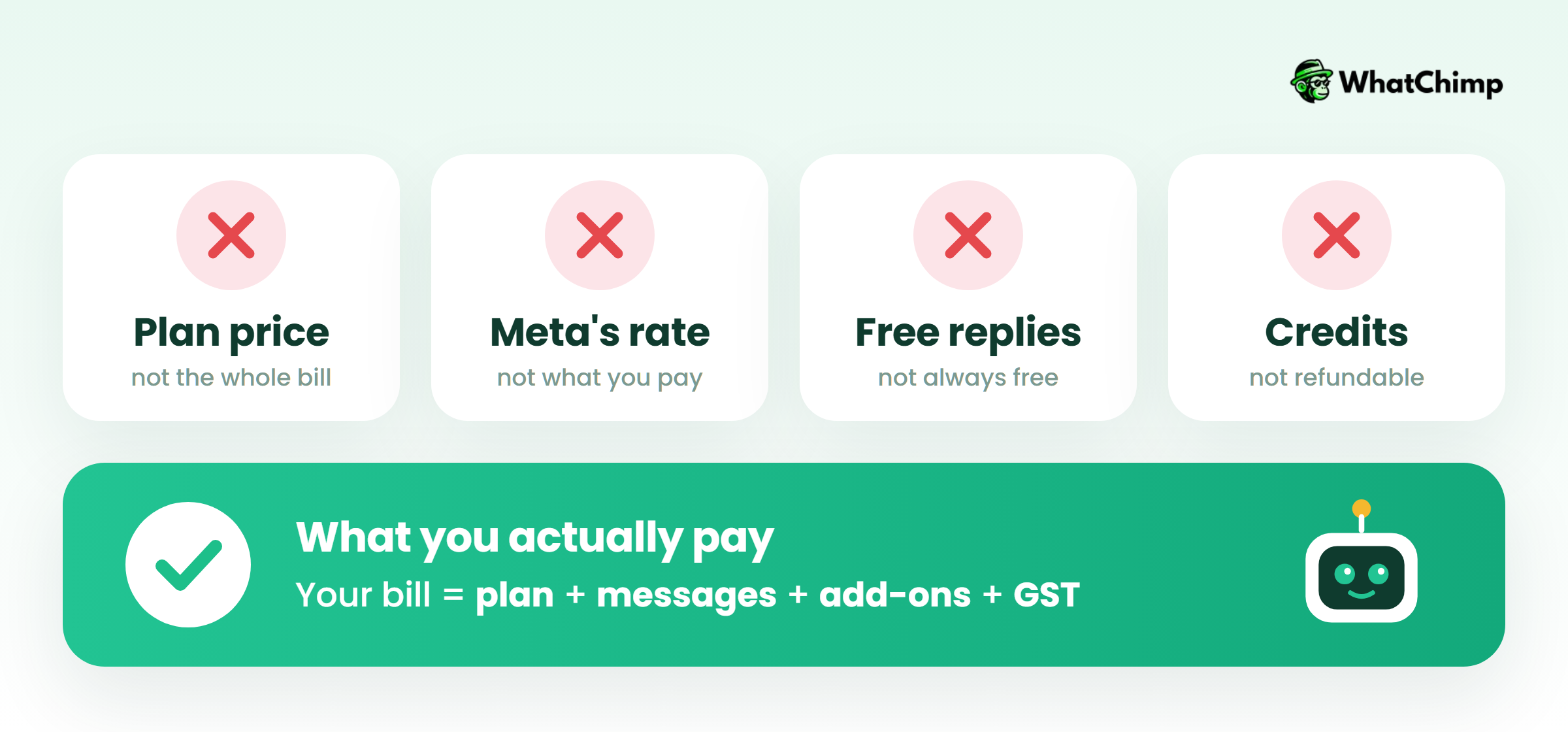
- ❌ “The plan price is my monthly cost.” It’s your platform fee. Messages, add-ons and GST come on top.
- ❌ “Messages are charged at Meta’s rate.” Wati bills from its own rate card, which sits above Meta’s (more on that below).
- ❌ “Customer replies are always free.” Since 1 October 2026, service messages are charged once a number goes past 1,000 a month.
- ❌ “I can get a refund on unused credits.” Wati’s page says no refunds on subscription or credit payments.
Can’t you just ask the sales team for one all-in number?
Technically, yes. Practically, no. Your bill depends on how many messages you send and which category they fall into, so nobody can quote it for you. You have to work it out yourself, and the next two sections show you how.
How does WhatsApp message pricing work in 2026?
This part applies to every WhatsApp Business API provider, not only Wati. It’s the core of your WhatsApp marketing cost.
1. You pay per delivered message, by category
Since 1 July 2025, Meta charges per delivered message, replacing the old 24-hour “conversation” pricing. Template messages fall into three categories: marketing, utility and authentication.
2. Meta’s India rates are under ₹1 per message
These are Meta’s India rates in ₹, as reported by the Free Press Journal on 30 September 2026:
| Message category | Meta’s rate (India, per message) | Typical use |
|---|---|---|
| Marketing | ₹0.8631 | Offers, launches, festive sales |
| Utility | ₹0.115 | Order updates, payment reminders |
| Authentication | ₹0.115 | OTPs |
| Authentication (international) | ₹2.4971 | OTPs to Indian numbers from a non-Indian business |
| Service | ₹0.115 after the free tier | Replies inside the 24-hour window |
The same report says marketing, utility and authentication rates for India were “unchanged on October 1”. Marketing last went up on 1 January 2026, from ₹0.7846 to ₹0.8631.
So that’s the WhatsApp message price at source. Anything above it is your provider’s margin.
3. What changed on 1 October 2026
Three changes hit Indian businesses this quarter, all from Meta’s pricing documentation:
- Service replies now cost money after 1,000 free delivered service messages per phone number per month. The free tier doesn’t roll over.
- Utility messages sent inside an open 24-hour window are now charged too.
- Chats that start from a click-to-WhatsApp ad on the Android or iOS app open a free window that “may remain open for up to 7 days”.
Wati’s help centre adds one detail of its own: it bills service messages “at the same rate as the applicable utility template rate in your market”, and “No volume-based discount applies to service messages.”
4. INR billing becomes mandatory on 31 December 2026
Meta started offering INR billing on 1 January 2026. Eligible Indian accounts must move to INR by 31 December 2026, and from 1 January 2027 Meta stops delivering messages from non-INR accounts of eligible Indian customers.
If your provider still bills you in dollars for messages, ask them this week how they’re handling the switch.
Meta can only change rates on 1 January, 1 April, 1 July and 1 October, with a month’s notice. So any WhatsApp for Business pricing you read is good for one quarter at most.
How much does Wati charge per message compared with Meta?
This is the line most pricing pages skip. It’s also the one that grows with every campaign you send.
eesel compared Wati’s 1 October 2026 rate card with Meta’s for India and found Wati’s Growth and Pro rates come to about 1.6x Meta’s rate for marketing and about 1.8x for utility and authentication. eesel also notes that “Wati doesn’t call the difference a markup anywhere.”
I couldn’t open Wati’s INR rate card myself (it’s a PDF linked from the pricing page), so the ₹ figures below are my arithmetic, not Wati’s quote. I’ve applied eesel’s ratios to Meta’s ₹ rates:
| Category | Meta’s rate | Estimated Wati rate (Growth/Pro) |
|---|---|---|
| Marketing | ₹0.8631 | about ₹1.38 |
| Utility | ₹0.115 | about ₹0.205 |
| Service (billed at utility rate) | ₹0.115 | about ₹0.205 |
Business plan customers get 5% off Wati’s rate card, which still leaves them well above Meta.
What the gap costs you at real volumes
Marketing messages only, before GST:
| Marketing messages a month | At Meta’s rate | At estimated Wati rate | Extra you pay |
|---|---|---|---|
| 10,000 | ₹8,631 | ₹13,800 | ₹5,169 |
| 50,000 | ₹43,155 | ₹69,000 | ₹25,845 |
| 100,000 | ₹86,310 | ₹1,38,000 | ₹51,690 |
Look at the bottom row.
At 1 lakh messages a month, the gap alone is more than three times the Business plan fee.
Before you sign, open the rate card PDF linked from Wati’s pricing page and check the marketing rate for your plan. If it differs from my estimate, use Wati’s number in the examples below.
What add-ons and hidden costs should you expect?
None of these are really hidden. They’re on Wati’s page. They just don’t make it onto the plan cards.
| Add-on | Price on Wati’s page |
|---|---|
| Automation triggers | ₹1,000/month (quantity not stated clearly) |
| Wati AI credits | ₹1,600/month (from 2,000 credits) |
| Shopify integration | USD 4.99/month |
| Extra WhatsApp number | ₹2,499/month per number |
| Onboarding and professional services | Custom quote |
Volume discounts on messages start “for over 1 million messages per month”.
1. Prepaid wallet: you pay before you send
Wati’s help centre says it plainly: “To send messages, you must maintain sufficient credits in your account balance.” If your wallet runs dry in the middle of a sale, your broadcast stops.
Credits aren’t refundable, so don’t over-top-up in your first month.
2. GST adds 18% to everything
Indian providers add 18% GST to both the platform fee and the message charges. MyOperator’s 2026 India pricing guide and the Free Press Journal both report this.
So a ₹10,000 bill is really ₹11,800.
Confirm the exact treatment with your CA, especially if you claim input tax credit.
What does Wati really cost? 3 worked examples
These are example businesses, not real customers. The plan prices come from wati.io (quarterly billing). The message rates are the estimates from the table above.
1. Small coaching centre: about ₹11,300 a month on Growth
Priya (our Pune coaching centre) uses Growth with 3 users and sends 5,000 marketing messages a month for batch launches and fee reminders.
| Line | Amount |
|---|---|
| Growth plan | ₹2,699 |
| 5,000 marketing messages × ₹1.38 | ₹6,900 |
| Subtotal | ₹9,599 |
| GST at 18% | ₹1,728 |
| Estimated monthly total | ₹11,327 |
The plan is under a quarter of her bill. At Meta’s rate, the same messages would cost ₹4,316.
2. Shopify D2C store: about ₹59,600 a month on Pro
Rohan runs a skincare store on Shopify. He has 6 people on the inbox, sends 30,000 marketing messages and 10,000 order updates a month.
| Line | Amount |
|---|---|
| Pro plan | ₹5,799 |
| 1 extra user | ₹1,299 |
| 30,000 marketing messages × ₹1.38 | ₹41,400 |
| 10,000 utility messages × ₹0.205 | ₹2,050 |
| Subtotal | ₹50,548 |
| GST at 18% | ₹9,099 |
| Estimated monthly total | ₹59,647 + $4.99 for Shopify |
There’s the hook from the top. A ₹5,799 plan, a bill of nearly ₹60,000.
At Meta’s rates his messages would cost ₹27,043 instead of ₹43,450. That’s about ₹16,400 a month before GST, just in the gap.
3. Support-heavy team: about ₹9,200 a month on Pro
Meera leads a 5-person support team for an appliance brand. They send 4,000 service replies and 2,000 utility messages a month, and their bots use more triggers than Pro includes.
| Line | Amount |
|---|---|
| Pro plan | ₹5,799 |
| Triggers add-on | ₹1,000 |
| 4,000 service replies (first 1,000 free) = 3,000 × ₹0.205 | ₹615 |
| 2,000 utility messages × ₹0.205 | ₹410 |
| Subtotal | ₹7,824 |
| GST at 18% | ₹1,408 |
| Estimated monthly total | ₹9,232 |
I’ve assumed Wati passes through Meta’s 1,000 free service replies. Ask them to confirm that in writing.
When is Wati worth the price?
I’ll be fair here, because Wati is a solid product for some businesses.
Wati makes sense when:
- ✅ You send over a million messages a month and can negotiate its volume discount
- ✅ You need Salesforce, 20M API calls or 80 messages a second, which Business offers
- ✅ You want a dedicated customer success manager (Business plan)
- ✅ You’ve built your workflows around Wati’s Astra AI agents and AI credits
It’s harder to justify when:
- ❌ Marketing broadcasts are most of your volume, because that’s where the rate-card gap is widest
- ❌ You’re a small team that keeps hitting the trigger cap
- ❌ You need a fourth user but don’t need anything else Pro offers
Is there a cheaper option with 0% markup?
Yes. This is where I talk about WhatChimp, so take it with that in mind.
WhatChimp is browser-based WhatsApp marketing software built on the official WhatsApp Business API, and we’re a Meta Business Partner. We add 0% markup on Meta’s WhatsApp conversation fees, so you pay Meta’s rate for every message and nothing on top.
Plans are billed in USD. As listed on our pricing page, Basic is $24 a month billed annually or $40 billed monthly, Pro is $60 billed annually or $100 billed monthly, and Enterprise starts at $119. We often run a launch coupon too, so check the page on the day.

1. The same three bills, with messages at Meta’s rates
| Example | Wati messages (est.) | Same messages at Meta’s rates |
|---|---|---|
| Coaching centre | ₹6,900 | ₹4,316 |
| Shopify D2C store | ₹43,450 | ₹27,043 |
| Support team | ₹1,025 | ₹575 |
Add the WhatChimp plan fee and taxes to those numbers to get your total. The bigger your marketing volume, the more the 0% markup is worth.
2. What’s included compared with Wati
| Wati | WhatChimp | |
|---|---|---|
| Message charges | Wati rate card (above Meta) | Meta’s rate, 0% markup |
| Automation and chatbot limits | 1K, 2K or 5K triggers a month | Unlimited chatbot sessions on every plan |
| Shopify | $4.99/month add-on | Included on every plan |
| Webhooks and API | Not on Growth | Included on every plan |
| Extra numbers | ₹2,499/month each | Up to 4 numbers on Pro |
| Team members | 3 (Growth), 5 (Pro) | 2 (Basic), 5 (Pro) |
Our Shopify integration and WhatsApp automations are where Rohan’s store would feel the difference first.
3. Limits you should know about
I’d rather you hear this from me than find it after signing up:
- Basic allows 2 team members and 5,000 subscribers
- The catalog, appointment booking, click-to-WhatsApp ads, forms and agent routing are Pro-only
Your team logs in from a browser and replies from the same number in a shared inbox. There’s a 7-day free trial, no credit card needed to start, and template approvals usually come through in about 10 seconds.
If you want to see your own bill at Meta’s rates before you commit, run a week of your normal campaigns on the trial and compare.
How do you estimate your own WhatsApp bill?
Here’s the checklist I use with every business that asks me about WhatsApp messaging cost.

Step 1: Count last month’s messages by category
Time required: 10 to 15 minutes
- Open your current tool or your order system
- Count marketing broadcasts, order updates, OTPs and support replies separately
- Write down how many support replies came in per phone number
Step 2: Price them at Meta’s rate first
Time required: 2 to 3 minutes
- Multiply each count by Meta’s ₹ rate from the table above
- Take 1,000 off service replies per number before you multiply
What you get:
- ✅ Your floor. No provider can legitimately charge less than Meta for messages.
Step 3: Ask for the provider’s rate card in writing
Time required: 5 minutes
Instead of: “Hi, what’s your price?”
Use: “Please share your INR rate card for my plan, how GST is applied, your minimum wallet balance and whether the 1,000 free service replies are passed through.”
Step 4: Add the plan, seats, add-ons and GST
Time required: 5 minutes
- Pick the plan that fits your user count and trigger volume
- Add extra seats, triggers, numbers and integrations
- Multiply the total by 1.18 for GST
Then compare that number across providers, not the plan cards.
For a deeper look at how API message charges work across providers, our WhatsApp Business API pricing guide goes category by category.
Conclusion
You now know that Wati pricing starts at ₹2,699 a month on quarterly billing, and that the plan fee is usually the smallest part of your bill.
Messages, add-ons and 18% GST do the real damage, and Wati’s rate card sits roughly 1.6x above Meta’s for marketing.
Today, take last month’s message counts and price them at Meta’s rates. That’s your floor. If you want to send at exactly that rate, start a free WhatChimp trial and run your next broadcast with 0% markup on Meta’s fees.
So, what’s your current plan fee as a share of your total WhatsApp bill?
FAQs
How much does Wati cost per month in India?
It costs ₹2,699 a month for Growth, ₹5,799 for Pro and ₹16,799 for Business on quarterly billing, as listed on wati.io on 6 November 2026. Monthly and annual billing change the price, so check the toggle. Messages, add-ons and 18% GST are extra.
Are WhatsApp message charges included in Wati plans?
No, they aren’t. You prepay credits into a wallet and Wati deducts each message at its rate card price. The Business plan gets 5% off that rate card.
Does Wati charge more than Meta per message?
Yes, it does. eesel’s comparison of the 1 October 2026 rate cards puts Wati at about 1.6x Meta’s rate for India marketing messages and about 1.8x for utility. Wati doesn’t call this a markup, but it’s the difference you pay.
| Category | Meta (India) | Wati vs Meta |
|---|---|---|
| Marketing | ₹0.8631 | about 1.6x |
| Utility | ₹0.115 | about 1.8x |
Are customer service replies free in 2026?
No, not all of them. Since 1 October 2026, Meta gives each phone number 1,000 free service messages a month and charges after that. Wati bills those at its utility rate, with no volume discount.
Can I add more users on Wati’s Growth plan?
No, you can’t. Growth is capped at 3 users. Pro includes 5 and charges ₹1,299 per extra user a month, and Business charges ₹2,199 per extra user.
What are Wati’s hidden costs?
They’re the costs that aren’t on the plan cards:
- ❌ Per-message charges above Meta’s rate
- ❌ Automation triggers beyond your cap
- ❌ Shopify at $4.99 a month and extra numbers at ₹2,499 each
- ❌ 18% GST on the whole bill
Is GST charged on WhatsApp message fees in India?
Yes, 18% GST applies to both the message charges and the platform fee, according to MyOperator and the Free Press Journal. Check with your CA how it affects your input tax credit.